A vendor wears a mask of Hindu nationalist Narendra Modi, prime ministerial candidate for main opposition Bharatiya Janata Party (BJP) and Gujarat’s chief minister, to attract customers at his stall selling masks of Indian political leaders ahead of general election in the southern Indian city of Chennai April 3, 2014. Reuters/Babu
The cat’s out of the bag, officially: After years of speculation, Narendra Modi, the Bharatiya Janata Party (BJP)’s candidate for prime minister of India, has admitted he has a wife. The revelation came when he filled out his nomination form in an election registry on Wednesday. Where it stated “married to,” he wrote, “Jashodaben.” It’s the first time Modi has ever publicly recognized his spouse’s existence.
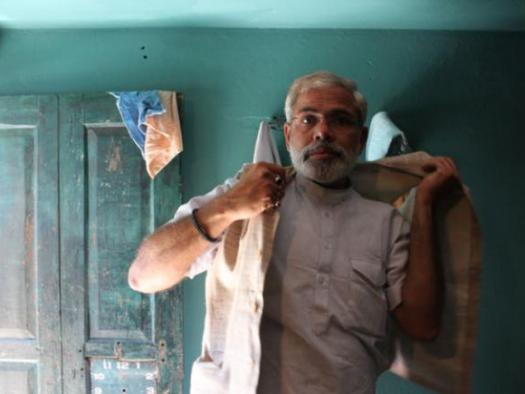
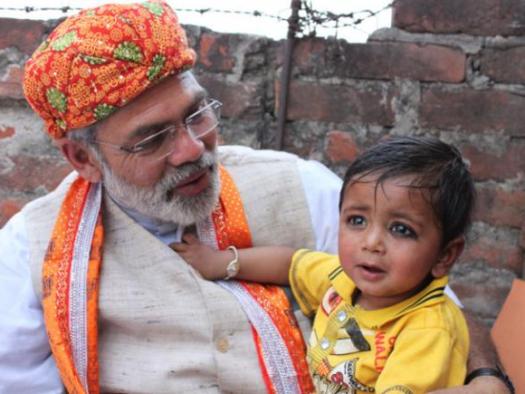
Abhinandan Pathak, a physical education teacher from Saharanpur, Uttar Pradesh, has taken three months off to travel around India and campaign in support of Narendra Modi. (Sonia Paul for The Caravan)
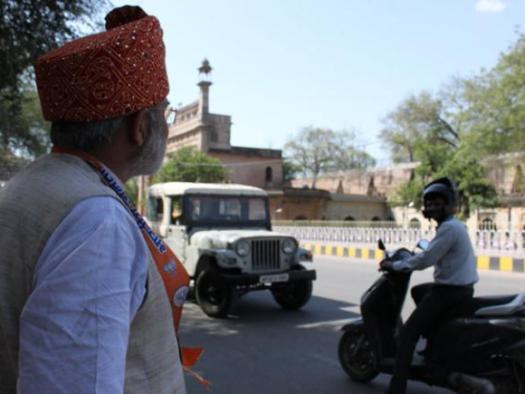
On the morning of 3 April, Abhinandan Pathak stepped off his sleeper compartment at Lucknow’s Charbagh Station. A posse of five men, including his 14-year-old son, Shivam, accompanied him. He wore white trousers and a white kurta, a gold Nehru vest, and a turban and neck sash coloured saffron and green—the colours of the Bharatiya Janata Party.
His silver hair and beard, and a pair of rimless spectacles, rounded off Pathak’s imitation of the BJP’s prime ministerial candidate, Narendra Modi.
Many believe a victory for Narendra Modi’s Hindu nationalists could add momentum to a conservative social backlash.
Some Indians worry a victory for the rightwing Hindu nationalist Bharatiya Janata party could signal more conservative trends in India. Photograph: Prakash Singh/AFP/Getty
The crisp lawns, water fountain and new walking path of Lohia Park attract people of all ages. Middle-aged women wearing tracksuit trousers paired with traditional Indian tops walk the trails with strollers in tow. Frisbees and kites fly in the air. And almost every day, couples embrace under a tree or on the grass, oblivious to all around them.
Priyanka Shivharee, 22, and Rohit Chaudhary, 25, are here because the park, in the northern Indian city of Lucknow, is one of the few places where they can get some privacy.
“Actually the park is a silent place,” said Chaudhary, who studies at a local engineering college along with his girlfriend of three years. “We can talk to each other and exchange emotions. So peaceful. That’s why we come here.”
A security personnel stands next to the symbol of India’s ruling Congress party, during a rally addressed by Congress party chief Sonia Gandhi ahead of the 2014 general elections, in New Delhi. Photo: REUTERS/Adnan Abidi
One-sixth of the world’s entire population will head to the polls this spring to cast their vote in India’s 16th parliamentary exercises. The hype surrounding the elections has been simmering for some time — India’s economy is in a huge slump, and ongoing domestic issues like unemployment, corruption and safety are plaguing the population from Kashmir in the north to Kanyakumari in the south.
Then last fall, Narendra Modi, the chief minister of the Indian state of Gujurat, announced his candidacy for prime minister. A new political party that grew out of an anticorruption movement, the Aam Aadmi Party, emerged from seemingly nowhere as a potential game changer in determining the outcome of the elections. And Rahul Gandhi, the scion of the Nehru-Gandhi family that has been at the helm of Indian politics since independence from the British in 1947, is also running for prime minister — without a whole lot of experience behind him.
What this all means is that the elections this year are some of the most important and highly contested in India’s history. Below, a crash course on the fundamentals you need to know to understand what’s at stake.
Men cheering for Narendra Modi, the prime ministerial candidate of Bharatiya Janata Party, at his rally in Lucknow, Uttar Pradesh, on March 2. Credit: Sonia Paul
LUCKNOW, India — As Narendra Modi gains momentum as the Bharatiya Janata Party’s candidate for prime minister, attention is turning to Muslim voters in the politically important state of Uttar Pradesh, who have been regarding him warily because of ties to right-wing Hindu groups that have attacked Muslims.
Uttar Pradesh has 80 seats in the lower house of the Indian Parliament at stake in the national elections, the most of any state in India. Muslims make up around 18 percent of the nearly 200 million people in the state and have historically provided support for the governing party in New Delhi, the Indian National Congress, and the regional Samajwadi Party, which is currently running the government in Uttar Pradesh.
Regional parties dominate Uttar Pradesh and could siphon off votes from either the Bharatiya Janata Party or the Indian National Congress so that neither gets an outright majority in the Lok Sabha, the lower house of Parliament. The Bharatiya Janata Party, or B.J.P., has won the parliamentary seat of the Lucknow district for the past several terms. Other districts in Uttar Pradesh are less settled.
Winning over Muslim voters in Uttar Pradesh requires a more complex strategy than just fielding a Muslim candidate, because they don’t vote as a bloc and they don’t base their vote solely on religion.
Sanatkada’s annual weaves and crafts festival being held at the Baradari complex in Lucknow, Uttar Pradesh, on Feb. 6. Credit: Sonia Paul
LUCKNOW, Uttar Pradesh — Lucknow, the capital of Uttar Pradesh, was buzzing with activity in recent days as Sanatkada, a well-known nonprofit in the city for women has been hosting its annual handicrafts festival, where vendors from across India come to sell their goods.
Aside from shopping, the festival, which began in 2010, offers musical and theater performances, panel discussions on literature and music, carnival rides for children and food from some of Lucknow’s most popular eateries. This year, however, the festival organizers decided to use this popular event to talk about one of the biggest topics in India today — feminism.
Mukulika Banerjee.Credit Courtesy of Sonia Paul“Voting in elections is considered sacrosanct by a large majority of Indians,” Mukulika Banerjee writes in the introduction to her new book, “Why India Votes.” That observation forms the backbone of the anthropology professor’s work, an ethnographic study of 12 sites in India during the 2009 general elections, which explores the motivations and opinions of Indian voters on a range of issues related to the electoral process.
As part of the Jaipur Literature Festival’s theme “Democracy Dialogues,” Dr. Banerjee, who is the associate professor of social anthropology at the London School of Economics, participated in several discussions on India’s social and political evolution. While conversations and questions during the panels often zeroed in on this year’s political players like Narendra Modi, Rahul Gandhi and the Aam Aadmi Party, India Ink spoke with Dr. Banerjee about the other factors motivating voter turnout, and why the act of voting is so meaningful for the majority of Indians.
Q.
Why India votes is a huge political question, but your book is actually an anthropological book and an ethnography. What is it about ethnography that lends itself useful to the study of politics?
In the days since the United States arrested Indian diplomat Devyani Khobragade, 39, for allegedly lying on her Indian housekeeper’s visa application, underpaying and forcing her to work longer hours than specified, the case has made a splash in both the US and India, whose media are covering the incident with very different emphases. In India, initial coverage focused on US mistreatment of a senior diplomat, while American media spilled more ink over the allegation that Khobragade was underpaying her maid. Subsequent Indian coverage, though, took up this theme, leading to some soul-searching about inequality in the country, which has an entrenched tradition of low-paid domestic help.
A view of Awadh Point, a three story building in Old Lucknow, Uttar Pradesh, on Nov. 9. Credit: Sonia Paul
The raised sign for Avadh Point on Victoria Road in Old Lucknow is missing two letters, the “O” and the “I.” The “D” in Avadh also hangs precariously, as if it is ready to become the third. The three-story building was constructed in 2005, but it stands dilapidated, walls thinning and paint peeling, as if it is as old as the Awadh culture it’s named after.
Since Nov. 6, the start of Muharram, which is the first month of the Islamic calendar and the period of mourning observed mostly by Shia Muslims, several figures are making their presence known at Avadh Point and other areas deemed sensitive in Lucknow for the next two and a half months: police officers.
“All the mess starts from here,” said Zeeshan Ansari, 21, a Sunni Muslim and recent college graduate who lives in the neighborhood. He was sitting on the patio of Avadh Point, gazing at the fruit vendors, shared auto-rickshaws, cycle rickshaws and throngs of people sharing the road in front of him.
Haunted by insecurity, relief camps for victims of communal riots in Uttar Pradesh witness spate of mass weddings.
Some 300 marriages are said to have taken place in the relief camps in Uttar Pradesh since the deadly riots [Yogesh Tiyagi, September 25]The setting was unusual for marital bliss, but it was no deterrent for the dozen-odd couples who tied the knot last week in a mass wedding at a relief camp for riot victims in Muzaffarnagar.
Having fled communal violence that recently swept parts of the northern Indian state of Uttar Pradesh and left scores dead and thousands homeless, the newly married couples of Malakpur relief camp held hands together and vowed to make a fresh beginning.
Mass weddings are not uncommon in India, where community and religious leaders sometimes host them for poorer communities to help ease their financial burden.
But a spurt of mass weddings at relief camps sheltering thousands displaced by the riots is evoking contrasting emotions. Some hail them as efforts to rebuild lives. Local authorities, however, see them as unnecessary distractions.






![Some 300 marriages are said to have taken place in the relief camps in Uttar Pradesh since the deadly riots [Yogesh Tiyagi, September 25]](https://sonipaul.me/wp-content/uploads/2014/11/2013103175225648734_20.jpg)
 Sonia Paul