British comedian and former Daily Show regular John Oliver has come out with a hilarious analysis of the Indian elections that’s currently gaining traction on social media. Among the topics he covers on his new HBO show Last Week Tonight: the “Americanization” of Indian media, the US’s apathy toward the elections, and Hindu nationalist prime ministerial candidate Narendra Modi’s emulation of famed rapper Tupac at Coachella.

You can watch the embed below, or see it on the official Last Week Tonight YouTube channel here.

This piece was originally published on April 28, 2014, on Link TV’s World News website.

bjp-twitter-a
The surging Hindu nationalist Bharatiya Janata Party (BJP) has had a lively social media presence during this year’s elections in India. Anyone who has ever combined a hashtag with “Modi,” “BJP,” “NaMo,” (a nickname of Narendra Modi here in India) or anything else related to Modi or the BJP has surely encountered Modi supporters either praising or defending their views. These “Moditards,” as some journalists have dubbed them, are generally passionate professionals who want nothing more than for Modi to lead the country, though some accounts are also suspected of being social media robots.

But an enterprising Indian who obviously has some programming skills did some investigating and found that most of these accounts are, in fact, fake Modi supporters.

Continue reading

The Supreme Court just granted legal recognition to transgender people, but India’s LGBTs won’t come out of the closet.

LUCKNOW, India — On April 15, India’s Supreme Court issued a landmark ruling allowing transgender people to identify as a third gender. The judgment directs the central and state governments to give them full legal recognition, including allotting them similar educational and job quotas as other minorities categorized as socially or economically disadvantaged. To date, transgender Indians — also known as hijras — were forced to select either “male” or “female” on all government forms and routinely faced ostracization due to their gender identity.

While gay rights activists and the LGBT community welcomed the decision, it flies in the face of a December 2013 Supreme Court ruling that recriminalized homosexuality. That ruling — which was criticized by two out of the three national parties contesting India’s general elections, currently underway — overturned a 2009 high court judgment that declared Section 377 of the Indian penal code unconstitutional. The British colonial law, dating back more than 150 years, criminalized sexual activities “against the order of nature” and had long been used to harass gay people.

The 2009 ruling was a watershed moment for gay rights in India. Openly gay-friendly bars and cafés opened across the country, Bollywood movies began featuring gay characters, and homosexuality began to be more accepted in the big cities. The following year, Delhi’s Queer Pride Parade attracted roughly 2,000 people — four times the number it did in 2008. The Supreme Court’s 2013 reversal drew criticism from HIV/AIDS groups, human rights campaigners, media icons and Indian politicians. Around the world, gay rights supporters organized a Global Day of Rage in more than 30 cities in protest.

Now there’s a strange tension between the two Supreme Court rulings: On one hand, transgender people have legal recognition; on the other, they may still be arrested for engaging in gay sex.

Continue reading

Reuters/Babu
A vendor wears a mask of Hindu nationalist Narendra Modi, prime ministerial candidate for main opposition Bharatiya Janata Party (BJP) and Gujarat’s chief minister, to attract customers at his stall selling masks of Indian political leaders ahead of general election in the southern Indian city of Chennai April 3, 2014. Reuters/Babu

The cat’s out of the bag, officially: After years of speculation, Narendra Modi, the Bharatiya Janata Party (BJP)’s candidate for prime minister of India, has admitted he has a wife. The revelation came when he filled out his nomination form in an election registry on Wednesday. Where it stated “married to,” he wrote, “Jashodaben.” It’s the first time Modi has ever publicly recognized his spouse’s existence.

Continue reading

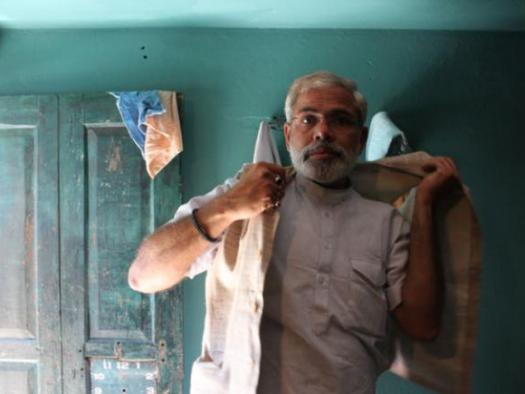
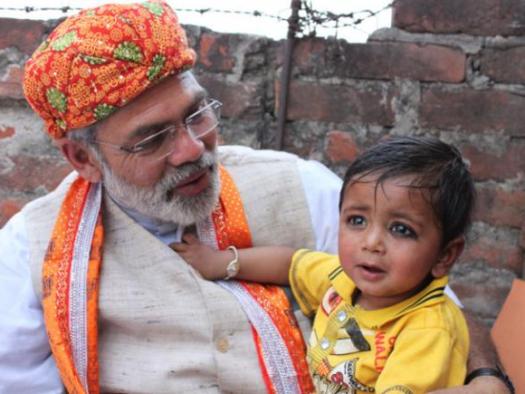
Abhinandan Pathak, a physical education teacher from Saharanpur, Uttar Pradesh, has taken three months off to travel around India and campaign in support of Narendra Modi. (Sonia Paul for The Caravan)

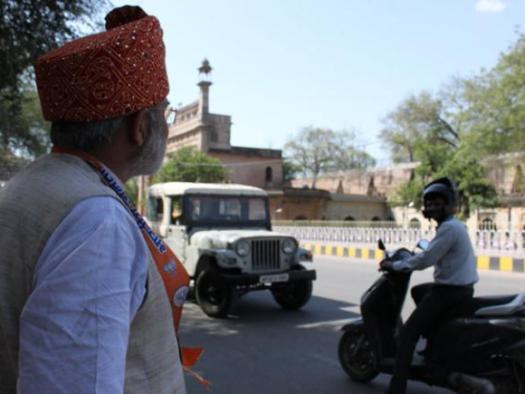
On the morning of 3 April, Abhinandan Pathak stepped off his sleeper compartment at Lucknow’s Charbagh Station. A posse of five men, including his 14-year-old son, Shivam, accompanied him. He wore white trousers and a white kurta, a gold Nehru vest, and a turban and neck sash coloured saffron and green—the colours of the Bharatiya Janata Party.

His silver hair and beard, and a pair of rimless spectacles, rounded off Pathak’s imitation of the BJP’s prime ministerial candidate, Narendra Modi.

Continue reading

Many believe a victory for Narendra Modi’s Hindu nationalists could add momentum to a conservative social backlash.

Some Indians worry a victory for the rightwing Hindu nationalist Bharatiya Janata party could signal more conservative trends in India. Photograph: Prakash Singh/AFP/Getty

The crisp lawns, water fountain and new walking path of Lohia Park attract people of all ages. Middle-aged women wearing tracksuit trousers paired with traditional Indian tops walk the trails with strollers in tow. Frisbees and kites fly in the air. And almost every day, couples embrace under a tree or on the grass, oblivious to all around them.

Priyanka Shivharee, 22, and Rohit Chaudhary, 25, are here because the park, in the northern Indian city of Lucknow, is one of the few places where they can get some privacy.

“Actually the park is a silent place,” said Chaudhary, who studies at a local engineering college along with his girlfriend of three years. “We can talk to each other and exchange emotions. So peaceful. That’s why we come here.”

Continue reading

REUTERS/Adnan Abidi
A security personnel stands next to the symbol of India’s ruling Congress party, during a rally addressed by Congress party chief Sonia Gandhi ahead of the 2014 general elections, in New Delhi.  Photo: REUTERS/Adnan Abidi

One-sixth of the world’s entire population will head to the polls this spring to cast their vote in India’s 16th parliamentary exercises. The hype surrounding the elections has been simmering for some time — India’s economy is in a huge slump, and ongoing domestic issues like unemployment, corruption and safety are plaguing the population from Kashmir in the north to Kanyakumari in the south.

Then last fall, Narendra Modi, the chief minister of the Indian state of Gujurat, announced his candidacy for prime minister. A new political party that grew out of an anticorruption movement, the Aam Aadmi Party, emerged from seemingly nowhere as a potential game changer in determining the outcome of the elections. And Rahul Gandhi, the scion of the Nehru-Gandhi family that has been at the helm of Indian politics since independence from the British in 1947, is also running for prime minister — without a whole lot of experience behind him.

What this all means is that the elections this year are some of the most important and highly contested in India’s history. Below, a crash course on the fundamentals you need to know to understand what’s at stake.

Continue reading

Men cheering for Narendra Modi, the prime ministerial candidate of Bharatiya Janata Party, at his rally in Lucknow, Uttar Pradesh, on March 2.
Men cheering for Narendra Modi, the prime ministerial candidate of Bharatiya Janata Party, at his rally in Lucknow, Uttar Pradesh, on March 2. Credit: Sonia Paul

LUCKNOW, India — As Narendra Modi gains momentum as the Bharatiya Janata Party’s candidate for prime minister, attention is turning to Muslim voters in the politically important state of Uttar Pradesh, who have been regarding him warily because of ties to right-wing Hindu groups that have attacked Muslims.

Uttar Pradesh has 80 seats in the lower house of the Indian Parliament at stake in the national elections, the most of any state in India. Muslims make up around 18 percent of the nearly 200 million people in the state and have historically provided support for the governing party in New Delhi, the Indian National Congress, and the regional Samajwadi Party, which is currently running the government in Uttar Pradesh.

Regional parties dominate Uttar Pradesh and could siphon off votes from either the Bharatiya Janata Party or the Indian National Congress so that neither gets an outright majority in the Lok Sabha, the lower house of Parliament. The Bharatiya Janata Party, or B.J.P., has won the parliamentary seat of the Lucknow district for the past several terms. Other districts in Uttar Pradesh are less settled.

Winning over Muslim voters in Uttar Pradesh requires a more complex strategy than just fielding a Muslim candidate, because they don’t vote as a bloc and they don’t base their vote solely on religion.

Continue reading

Sanatkada's annual weaves and crafts festival being held at the Baradari complex in in Lucknow, Uttar Pradesh, on Feb. 6.
Sanatkada’s annual weaves and crafts festival being held at the Baradari complex in Lucknow, Uttar Pradesh, on Feb. 6. Credit: Sonia Paul

LUCKNOW, Uttar Pradesh — Lucknow, the capital of Uttar Pradesh, was buzzing with activity in recent days as Sanatkada, a well-known nonprofit in the city for women has been hosting its annual handicrafts festival, where vendors from across India come to sell their goods.

Aside from shopping, the festival, which began in 2010, offers musical and theater performances, panel discussions on literature and music, carnival rides for children and food from some of Lucknow’s most popular eateries. This year, however, the festival organizers decided to use this popular event to talk about one of the biggest topics in India today — feminism.

Continue reading

Vishwajyoti Ghosh, artist and graphic novelist.
Vishwajyoti Ghosh, artist and graphic novelist.Credit: Sonia Paul

Vishwajyoti Ghosh, a graphic novelist and artist based in Delhi, is curator of the book “This Side That Side: Restorying Partition,” an anthology of graphic narratives from India, Pakistan and Bangladesh. His first graphic novel, “Delhi Calm,” was published in 2010. At the Jaipur Literature Festival, Mr. Ghosh spoke with India Ink about the significance of collaborating with 48 different contributors, and what it means for younger generations to retell the history of Partition in a graphic format.

Q.

What do you think it is about the graphic element of the anthology that makes the stories of Partition come alive?

Continue reading